



Between 2023 and 2025, global patent applications related to bathroom mirrors grew at an average annual rate of over 15%. Patents are the "map" of an industry's technology roadmap - where money and R&D resources flow, patents concentrate.
Recent patent data shows innovation is heavily concentrated in three key areas - and they clearly indicate where product technology is heading.
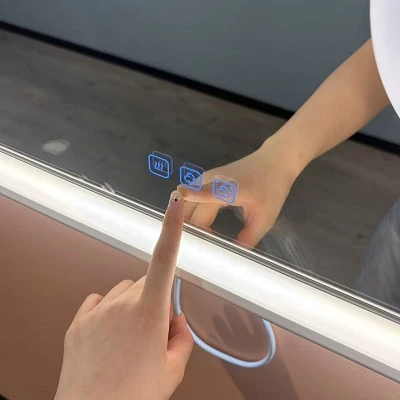
Area 1: Touch and sensor interaction technology
This is currently the largest patent category. Traditional mechanical buttons are being replaced by capacitive touch sensors. The advantage of capacitive touch is a completely flat, seamless mirror surface that is easy to clean and sanitize.
But patents are going further. New filings are covering multi-modal interaction - combining voice, gesture, facial recognition, and touch control. Some patents already cover smart mirror control methods based on multi-modal perception data.
For your products, both radar and touch sensors fall within this patent area. Competitors are moving from "single-point touch" to "multi-modal interaction". As long as you maintain modular design, future sensor upgrades won't require redesigning the entire mirror.
Area 2: Intelligent control and algorithm optimization
This is the fastest-growing area. Traditional smart mirrors only offer two lighting modes - full on or full off. New patents are covering much finer control logic.
One representative example is a low-power dimming and color control method based on light and color adjustment. The patented technology uses a sensor layer to collect multi-dimensional data and a control layer that processes it through an SVM-PCA hybrid model to coordinate light adjustment and defogging. The value: the system can dynamically adjust heating temperature and lighting parameters based on the mirror's fogging level.
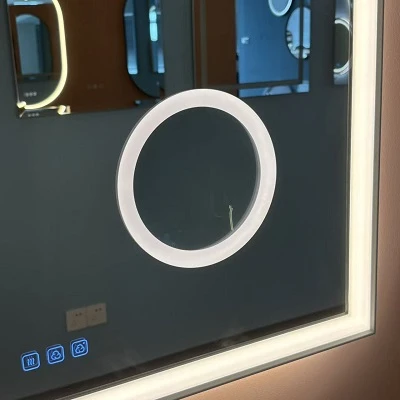
Another fast-growing area is adaptive LED control based on usage behavior prediction. In simple terms: the mirror learns the user's habits and anticipates when to adjust brightness and color temperature.
The implication for your products: "smart" is moving from "manual adjustment" to "automatic adaptation". Your in-house driver advantage means control logic upgrades don't require hardware changes - just algorithm updates.

Area 3: Low-power defogging and energy-saving technology
Defogging is a must-have function, but traditional heating film defoggers consume significant power. Patent data shows that low-power defogging coating materials and energy-saving defogging detection methods are now the focus.
Some patents already cover energy-saving defogging detection methods and systems based on humidity sensing. Technology forecasts for 2030 suggest that products based on more precise humidity sensing algorithms and ultra-low standby power will become mainstream.
The implication for your products: defogging is no longer "heating when turned on" but "heating only when needed". For hotels and commercial projects, this means lower operating costs and longer product life.
Who holds these patents?
Chinese applicants now hold 29.7% of bathroom mirror-related patents. Companies like Huawei and Xiaomi have also entered the smart mirror patent space. This indicates that bathroom mirrors are developing real technological barriers - no longer a simple product that "anyone can make".
What does this mean for buyers?
Cross-analysis of customs data shows that companies with independent R&D capabilities and patents achieve significantly higher unit prices and profit margins than OEM-focused manufacturers. Industry divergence is already visible - companies with technical accumulation are pulling away from pure assembly factories.
A simple question to ask potential suppliers: "How many patents do you hold in this category, and where are they focused?"
The answer will tell you whether you're dealing with a manufacturing company that invests in technology, or an assembly operation that follows market trends.
If you're evaluating long-term suppliers, we can walk you through our patent portfolio and show you what it means for your product road map. Let's set up a call.