



For years, "smart" in bathroom mirrors meant adding more features - more lights, more switches, more functions. But since 2026, a more fundamental shift has taken place: moving from "stacking features" to "modular integration".
If you're sourcing mirrors and find yourself constantly juggling different function combinations, we should talk. Our modular solutions may already have the configuration you need.
What is modular control?
In short, it integrates dimming, defogging, sensing, Bluetooth, clock, and charging into a single control module. This module is mounted behind or below the mirror, acting as an independent "smart hub".
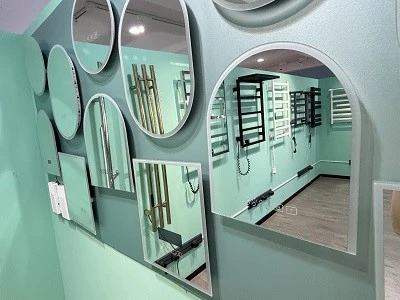
The old way: LED strip with one driver, defogger with its own switch, sensor with another controller - each function with its own wiring and box. The result is a messy back, complex installation, and difficult maintenance.
The modular way: all functions are managed through one module - dimming, defogging, sensing, Bluetooth, clock, charging - all from the same box. Clean installation, easy maintenance, and adding or removing functions only requires swapping the module, not rewiring the entire mirror.
Why does this shift matter?
For B2B buyers, the changes are direct and measurable:
1. More flexible customization without redesign.
Previously, "dimming + defogger + sensor" and "dimming + defogger + Bluetooth" were two different products, requiring separate molds and separate inventory. With modular design, the same mirror becomes a different product simply by swapping the control module. For buyers, this means fewer SKUs to manage and faster sample lead times.
2. Lower maintenance costs.
In traditional designs, drivers, sensors, and switches are soldered or glued to the back of the mirror. If any component fails, the entire mirror must be removed for repair. Modular designs use plug-and-play architecture with standardized internal mounting brackets, allowing independent replacement of drivers and sensors. In hotel or apartment projects, maintenance time drops from hours to minutes.
3. Simpler installation.
Traditional LED mirrors require connecting multiple wires - LED strips, defogger, sensor - each to its own driver. This demands higher skill from electricians. Modular solutions consolidate all functions into one module, requiring only a power connection and module interface. For bulk installation projects, the labor cost difference is real.
Where is the industry heading?
In April 2026, a company officially released a multi-function control module for bathroom mirror lights. This module integrates eight major functions - smart dimming, one-touch defogging, motion sensing, Bluetooth audio, clock display, dual-channel power supply, storage expansion, and health modules.
This is not a concept product. It is already shipping in volume. More importantly, modular design allows free combination - install what the customer needs, skip what they don't. This keeps costs under control while preserving customization flexibility.
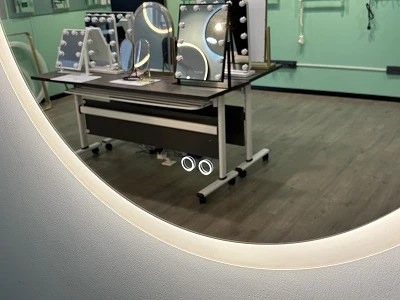
The industry is moving from "fixed feature sets" to "configurable function platforms". Future competition in bathroom mirrors will not be about who has more features, but who has the more mature and reliable modular solution.
What does this mean for buyers?
If your supplier is still using traditional methods - separate wiring for each function - they will struggle in the modular era. Modularity is not just "more advanced". It directly affects customization lead time, maintenance cost, and installation efficiency.
A simple question to ask potential suppliers: "Are your function modules independent, or integrated into one control box?"
The answer will affect everything from sample to mass production, from installation to after-sales support.
We design and manufacture our own control modules in-house. If you're evaluating suppliers, we can send you our module specifications and discuss your project needs directly.